Can You Pave a Driveway in the Rain?
Paving a new driveway is a major investment, and timing the project around the weather can make the difference between a surface that lasts 25 years and one that starts failing within months. One of the most common questions homeowners and property managers ask is: can you pave a driveway in the rain?
The short answer is, sometimes, but rarely should you. The long answer depends on the material, rainfall intensity, ground conditions, and the expertise of the paving crew. This guide breaks down the science, the risks, and the professional best practices so you can make the smartest decision for durability, cost, and long-term performance.
Short Answer — Can You Pave a Driveway in the Rain?
Yes, paving in the rain is technically possible in very light drizzle with proper preparation and commercial-grade equipment but it is not recommended in most situations.
Quick verdict:
Asphalt: Light rain may be manageable if the base is dry and temperatures are high enough. Heavy rain is a hard stop.
Concrete: Rain at any stage of pouring or finishing can permanently weaken the slab.
It might be possible when:
Rain is extremely light and brief
The sub-base is fully dry and stable
Material temperatures can be maintained
Protective coverings are used immediately
It is a strict NO when:
Water is pooling on the surface
The ground is saturated
Rainfall is steady or heavy
Temperatures are already low
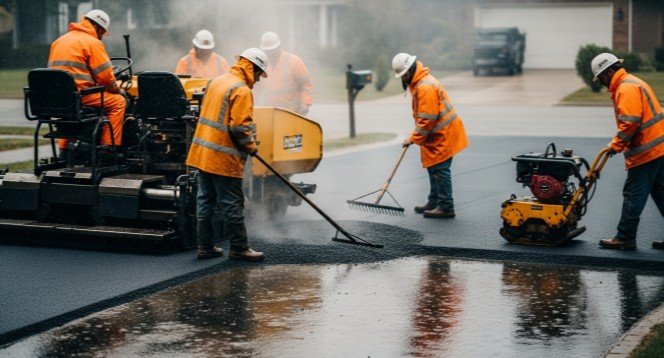
Why Weather Conditions Matter in Driveway Paving
How Moisture Affects Asphalt Installation
Asphalt must be placed and compacted while hot. Rain accelerates cooling, which prevents proper compaction. Poor compaction leads to:
Air voids
Weak bonding
Early cracking and rutting
How Rain Impacts Concrete Curing and Strength
Concrete relies on a precise water-to-cement ratio. Rain adds uncontrolled moisture, causing:
Surface scaling
Dusting
Reduced compressive strength
Uneven curing
Base Layer Stability and Water Damage Risks
A wet sub-base is one of the biggest causes of driveway failure.
Soil compaction failure
Shifting and sinking
Premature deterioration
Can You Pave a Driveway in the Rain?
Can You Pave a Driveway in the Rain with Asphalt?
Temperature requirements: Asphalt is typically installed between 275–300°F. Rain cools it too quickly.
Cooling rate problems: Faster cooling = less time for proper rolling and density.
Bonding issues: Water blocks adhesion between layers.
Result: Shorter lifespan and higher maintenance costs.
Can You Pave a Driveway in the Rain with Concrete?
Water-cement ratio imbalance: Even small amounts of rain weaken the mix.
Surface damage: Scaling and flaking are common.
Structural weakness: Reduced load-bearing capacity.
Result: Permanent strength loss — not just cosmetic damage.
Pavers, Gravel, and Permeable Driveways in Wet Conditions
These systems are more tolerant because they are modular and rely less on curing chemistry. However, the base still must be dry and compacted.
Ideal Weather Conditions for Driveway Paving
Temperature Range for Asphalt vs Concrete
Asphalt: 50°F and rising
Concrete: 50–85°F for optimal curing
Humidity, Wind, and Ground Moisture Levels
Low ground moisture is more important than light rain. A dry, stable base is critical.
Seasonal Best Time for Driveway Installation
Late spring through early fall offers the most consistent results.
What Professionals Do When Rain Is in the Forecast
Step 1 – Monitoring Weather and Ground Conditions
Contractors track radar, temperature, and dew point — not just the chance of rain.
Step 2 – Preparing and Protecting the Sub-Base
They ensure the base is compacted and covered if showers are possible.
Step 3 – Adjusting Material Temperature & Mix
Hotter asphalt loads or modified concrete mixes may be used.
Step 4 – Using Tarps, Tents, and Rapid Compaction
Crews work faster and protect fresh surfaces immediately.
Step 5 – Post-Installation Protection and Curing
Plastic sheeting or curing compounds shield the surface from damage.
Real-Life Scenarios: What Happens If You Pave in the Rain
Light rain asphalt job: Minor surface texture issues but structurally sound due to dry base and fast compaction.
Heavy rain concrete pour: Surface washed out, requiring full replacement.
Cost reality: Rescheduling may cost hundreds — repairs cost thousands.
Warranty impact: Many contractors void warranties if paving occurs in rain.
Paving a Driveway in Dry vs Rainy Conditions
| Factor | Dry Conditions | Light Rain | Heavy Rain |
|---|---|---|---|
| Asphalt durability | Maximum lifespan | Slight reduction | Major failure risk |
| Concrete strength | Full strength | Surface defects | Severe weakening |
| Installation quality | Optimal | Inconsistent | Poor |
| Project cost | Predictable | Slight increase | High repair cost |
| Longevity | 20–30 years | 15–20 years | 5–10 years |
| Risk level | Low | Moderate | Extreme |
Risks Homeowners Take by Paving in the Rain
Wasted Material and Labor Costs
Wet conditions often mean rework.
Surface Cracks, Pitting, and Uneven Finish
Water interferes with proper finishing.
Drainage and Foundation Failure
A weak base leads to sinking and pooling.
Voided Warranties from Contractors
Most professional guarantees require proper weather conditions.
Smart Alternatives If It Starts Raining on Paving Day
Reschedule for better conditions
Complete only the base work
Use temporary gravel access
Cover and protect prepared areas
Expert Tips to Ensure a Long-Lasting Driveway
Hire contractors who follow weather-based scheduling
Test soil moisture before installation
Choose materials suited for wet climates
In high-rainfall regions like Buffalo, prioritize drainage design and proper base depth
People Also Ask About Paving in the Rain
How long after rain can you pave a driveway?
Typically 24–48 hours, once the base is completely dry and firm.
Can asphalt be laid on wet ground?
No. It prevents proper compaction and bonding.
What happens if it rains on fresh concrete?
It weakens the surface and reduces overall strength.
Does rain damage a newly paved driveway?
Yes — especially before compaction or curing is complete.
Can sealcoating be done in the rain?
No. It requires a fully dry surface.
What temperature is too cold or wet for paving?
Below 50°F or when the base is saturated.
FAQs — Can You Pave a Driveway in the Rain?
Is light drizzle safe during driveway paving?
Only in controlled professional conditions with a dry base.
Can professionals use covers to continue paving?
Yes, but only for brief, light rain.
How do you protect fresh asphalt from rain?
Rapid compaction and immediate covering.
Will rain make my driveway weaker long term?
In most cases, yes.
Is it better to wait even if the schedule is tight?
Waiting is almost always the cheaper option.
Can permeable driveways be installed in wet weather?
Sometimes, if the base remains stable.
How do contractors test if the ground is too wet?
Compaction tests and visual stability checks.
Does rain affect driveway resurfacing the same way?
Yes — bonding and curing are still critical.
Conclusion — Should You Ever Pave a Driveway in the Rain?
So, can you pave a driveway in the rain? The expert recommendation is clear: only under very limited, controlled conditions — and even then, it carries risk.
For maximum lifespan, structural integrity, and warranty protection, postponing the project until the weather is dry is almost always the smartest and most cost-effective decision.
A driveway is built to last decades. Waiting a day or two for the right conditions ensures you get the durability, performance, and value your investment deserves. Always work with experienced, weather-aware paving professionals who prioritize long-term quality over short-term scheduling.